




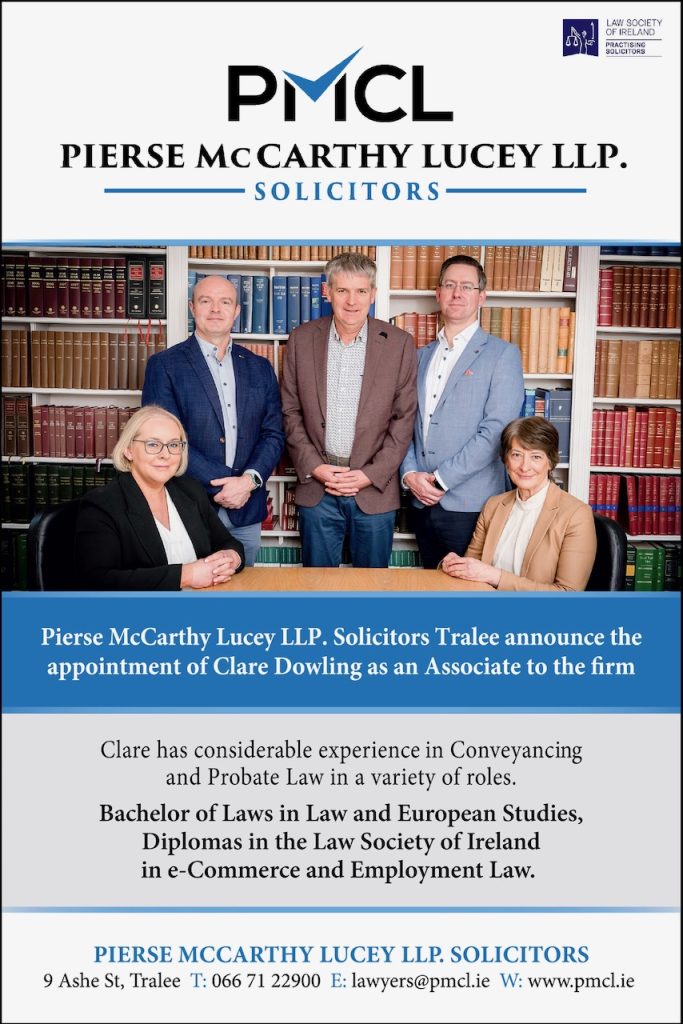
 .
 Clare Dowling.
Experienced solicitor, Clare Dowling LL.B., of Pierse McCarthy Lucey LLP Solicitors, has advice on why you should make a Will…
A will is a written document that sets out what you would like to happen to your possessions after you die.
Making a Will ensures your money, property, and other possessions go to the people or perhaps charitable causes that you choose.
It can help prevent family disputes and reduces legal complications. If you have children under the age of 18 years, your Will might also contain provision for appointing Guardians to look after them in the event of your death.
Your spouse or civil partner has a ‘legal right share’ to your Estate. This means that they are entitled to benefit from your Will, even if you do not provide for them in your Will.
If you do not have children, your spouse or civil partner’s legal right share is one half of your Estate. If you have children, your spouse or civil partner’s legal right share is one third of your Estate.
If you die without making a Will, you are said to die ‘intestate’. In Ireland, if someone dies without a valid Will (intestate), their estate is distributed according to the Succession Act 1965 based on a strict priority of relatives.
In other words, if you do not make a Will, the law decides who inherits, which may not reflect your intentions.
Overall, a Will gives clarity, control, and peace of mind for you and your loved ones.
In the case of an Intestacy, priority is given as follows:-
• Married/Civil Partner, no children → your spouse inherits your entire Estate
• Married/Civil Partner, with children → your spouse inherits two thirds of your Estate and the remaining one third is divided equally among your children
• Children, but no spouse or civil partner→ your children inherit your entire Estate equally
• No Spouse/Civil Partner and no children → your parents inherit your entire Estate
• No Spouse/Civil Partner, no children, both parents deceased → your siblings inherit your Estate (in equal shares if more than one)
There are very strict rules around the making of Wills, and it is always best to consult a solicitor.
Your solicitor’s job is to make sure your Will is legally valid, contains your wishes and is capable of being implemented on your death. In order to make a valid Will, you must have, in the eyes of the law, the mental capacity to do so.
This means you must understand and be able to decide what you are doing. Your solicitor will check that you are not acting under any undue influence (e.g. some other person is exerting control over your wishes), and you are making your Will of your own free will).
If you wish to make a Will with your solicitor, you should have details of all your assets i.e. Details of any property you own, bank accounts, company shares, private pensions etc and details of any liabilities you owe e.g. mortgages ,loans etc.
• Solicitor Clare Dowling LL.B., who recently joined Pierse McCarthy Lucey LLP Solicitors as an Associate considerable experience in Conveyancy, Probate and Family Law in a variety of roles.
She is happy to help any prospective clients with their enquiries. Clare is contactable at Pierse McCarthy Lucey LLP, Solicitors, 9 Ashe Street, Tralee, Co. Kerry Tel 066 7122900 E-mail clare.dowling@pmcl.ie | Web www.pmcl.ie.
The material contained in this article is for general information purposes only and does not constitute legal or other professional advice. No liability whatsoever is accepted by Pierse McCarthy Lucey LLP for any action taken in reliance on the information contained in this article.











We Patrick and Mary oSullivan would be interested in making a will,we have four sons and would like our house and any monies to be divided between them.Also what does it cost to make a will please?.
What if the executor of a will is a solicitor who has not carried out his duties.? No probate, etc 10 years after death.